2 minute read / August 31, 2024
There is often confusion about the countries included in the EU, EEA, EFTA, Schengen as well as those one having the Euro currency and those that don’t, despite being part of the EU.
After Brexit (2021), the number of EU countries are 27 (Austria, Belgium, Bulgaria, Croatia, Cyprus, Czech Republic, Denmark, Estonia, Finland, France, Germany, Greece, Hungary, Ireland, Italy, Latvia, Lithuania, Luxembourg, Malta, Netherlands, Poland, Portugal, Romania, Slovakia, Slovenia, Spain, Sweden) whereas the EFTA (European Free Trade Association) countries are Iceland, Liechtenstein, Norway, and Switzerland.
The EEA (European Economic Area) countries are the 27 EU countries + Iceland, Liechtenstein and Norway.
The Schengen countries groups is trickier, because the list is not what someone would imagine: as a matter of fact, while not all EU countries belong to the Schengen group, some non-EU do:
The EU countries using the Euro currency are not all 27 EU member states, but 20 of them: Austria, Belgium, Croatia, Cyprus, Estonia, Finland, France, Germany, Greece, Ireland, Italy, Latvia, Lithuania, Luxembourg, Malta, the Netherlands, Portugal, Slovakia, Slovenia and Spain.
Besides, Andorra, Monaco, San Marino and Vatican City use the Euro as their national currency, in agreement with the EU. A number of countries and territories use the Euro as their de facto currency such as Kosovo and Montenegro.
Finally, a good map summarising the situation (apart from the Euro currency use) is displayed below:
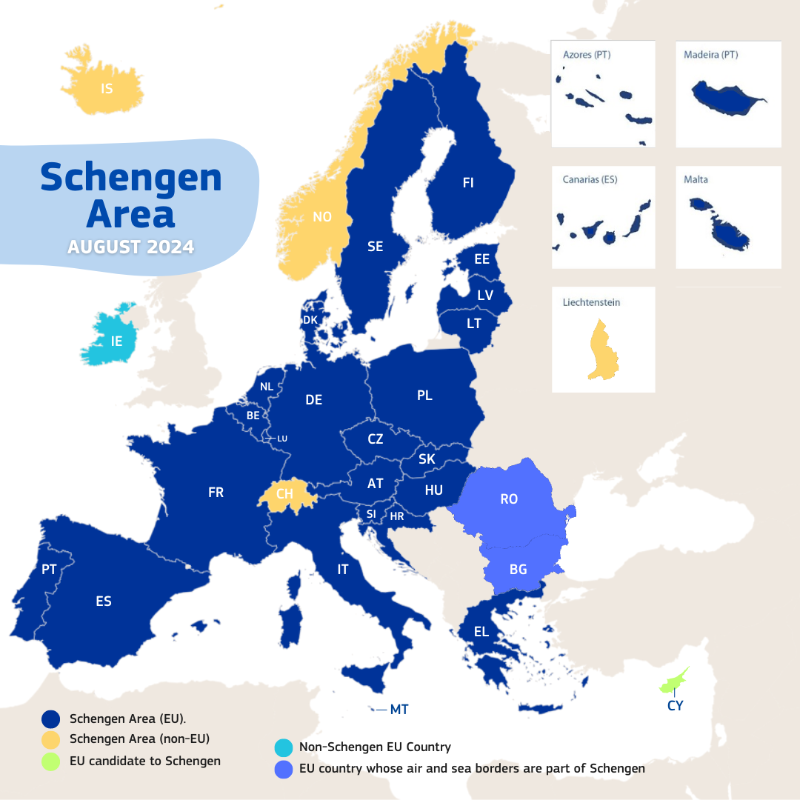
(Source: European Commission)
Article written by human beings without any use of AI. EPN Consulting Research and Innovation Ltd. Copyright 2024